
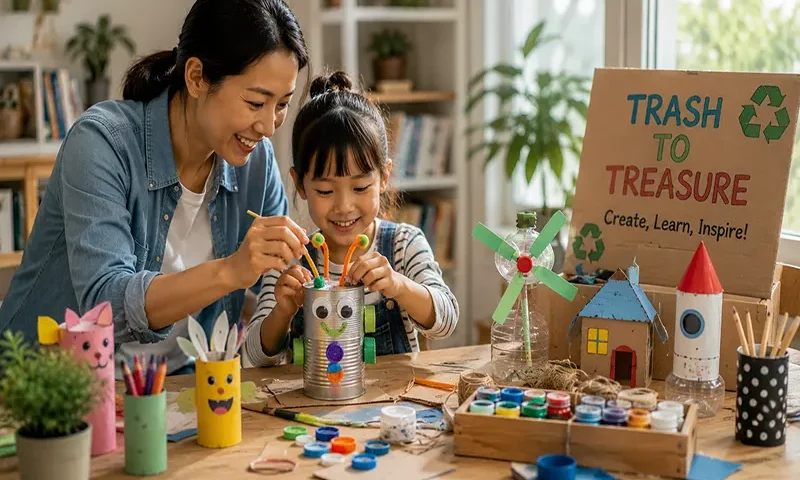
In the modern household, the recycling bin is often viewed as a place to discard unwanted clutter. But for a child, that same bin is a goldmine. When we view “trash” through the lens of potential, we transform a simple yogurt cup or a discarded cardboard tube into a laboratory for engineering, art, and scientific discovery.
“Recycled crafting” is more than just a way to save money on expensive art supplies; it is a powerful educational philosophy. It teaches children to look at the world with an investigative eye, fostering resourcefulness, environmental stewardship, and the critical thinking skills needed to turn ordinary objects into extraordinary tools.
The “Educational Lab” Approach: Four Pillars of Play
To get the most out of your recycled materials, try organizing your projects into four specific learning pillars. This ensures that every craft serves a deeper educational purpose beyond just “keeping them busy.”
1. Engineering & Physics (Construction)
Cardboard, plastic containers, and bottle caps are the ultimate building blocks. They teach children the fundamentals of structural integrity, balance, and weight distribution.
2. Scientific Inquiry (Experiments)
Use household “junk” to test theories. Can a toilet paper roll be a telescope? Can a yogurt cup be a telephone? These experiments turn abstract concepts into tangible, physical experiences.
3. Artistic Exploration (Sensory/Tactile)
Transforming old magazines, scrap paper, and egg cartons into mixed-media collages allows children to experiment with color, texture, and composition.
4. Logical Literacy (Sorting & Math)
Recycled items are perfect for sorting games. Categorizing plastic lids by color or size, or counting egg carton compartments, builds early numeracy skills in a fun, hands-on way.
Star Projects: Trash to Treasure
1. The Cardboard “Marble Run”
- Materials: Toilet paper rolls, paper towel tubes, duct tape, and a marble (or ping-pong ball).
- The Concept: Gravity and momentum.
- Why it Matters: This is a masterclass in spatial reasoning. As children tape the tubes to a wall or a door, they must calculate angles and heights to ensure the marble successfully travels from top to bottom.
2. The Egg-Carton Ecosystem
- Materials: A recycled egg carton, soil, and quick-sprouting seeds (like beans or radish).
- The Concept: Introduction to botany and life cycles.
- Why it Matters: The individual cups of the egg carton act as perfect mini-greenhouses. It teaches children about nurturing, patience, and the biological needs of plants.
3. Magazine “Mosaic” Portraits
- Materials: Old magazines, glue, and cardstock.
- The Concept: Color theory and fine motor skills.
- Why it Matters: Tearing and cutting magazine scraps into tiny pieces to create a larger image helps develop the hand strength and precision needed for writing.
4. The “Milk-Jug” Bird Feeder
- Materials: A clean, empty plastic milk jug, twine, and birdseed.
- The Concept: Ecology and animal behavior.
- Why it Matters: This encourages children to observe the natural world. It turns your yard or balcony into a site for data collection: Which birds come to visit? What time of day are they most active?
5. The Yogurt-Cup “Telephone”
- Materials: Two empty yogurt cups and a long piece of string.
- The Concept: Sound wave transmission.
- Why it Matters: By keeping the string taut, children can “send” their voices. It introduces the physics of vibration and sound transmission in a way that feels like pure magic.
Managing the “Recycled Craft Station”
To make this a sustainable habit, set up a “Maker’s Bin” in your home. This is a dedicated spot where clean, saved materials live. When your child is bored, they don’t ask, “What should I do?” They go to the Maker’s Bin and ask, “What can I build?”
- The Containment Strategy: Use a clear storage tote or a designated corner.
- The “Clean-First” Rule: Teach children that anything going into the bin must be clean and dry. This prevents odors and keeps the craft station hygienic.
- Independent Access: Place the bin at a height where children can reach it easily. If they have to ask permission to access materials, the “magic” of spontaneous invention is lost.
Quick Reference Checklist: Essential “Trash” to Save
Keep your eyes peeled for these high-value items:
- Cardboard Tubes: Toilet paper and paper towel rolls are structural gold.
- Egg Cartons: Perfect for sorting games, seed starters, and paint palettes.
- Clear Plastic Containers: Yogurt cups and fruit tubs are ideal for measuring and water play.
- Bottle Caps: Small, colorful, and perfect for counting, stacking, or “robot eyes.”
- Old Magazines: A endless source of texture, color, and images for collages.
- Small Boxes: Cereal, tea, and shipping boxes are the foundation for any building project.
The Final Lesson
The greatest gift you give your child when you craft with “trash” is the gift of resourcefulness. In a world of consumerism, teaching a child that they can make what they need—rather than just buying it—is a profound lesson in agency.

