
For many children, the transition from “learning to read” to “reading to learn” is one of the most significant hurdles in elementary education. As the complexity of vocabulary and syntax increases, the joy of discovery can sometimes be buried under a mountain of repetitive worksheets and high-stakes spelling tests.
However, literacy doesn’t have to be a chore. Play is the most effective way to build fluency, confidence, and vocabulary retention. When learning is gamified, the stakes feel lower, making children more willing to take risks, guess at words, and explore language with curiosity rather than anxiety.
The Literacy Lab: Four Pillars of Play
To make language learning stick, we need to engage different parts of the brain. By rotating through these four categories, you can ensure a well-rounded approach to literacy:
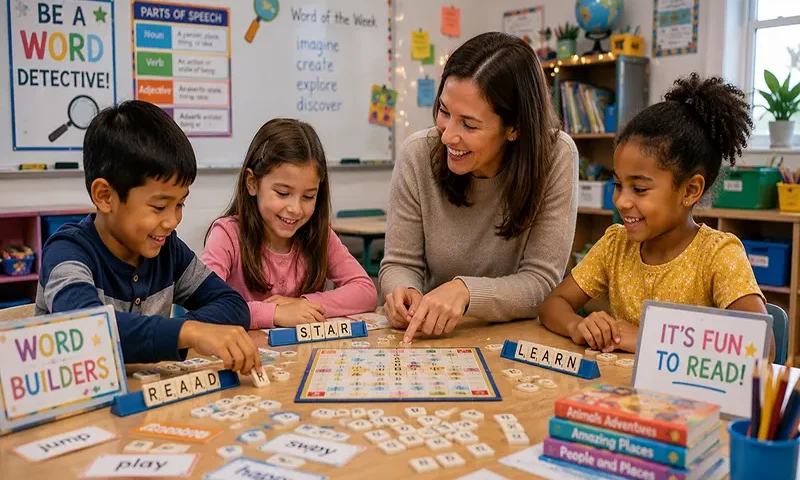
- Tactile & Sensory Spelling: Using the hands to “build” words helps reinforce orthographic patterns through motor memory.
- Movement-Based Literacy: Getting the “wiggles” out while practicing sounds keeps active learners focused.
- Strategic & Social Games: Learning to play by the rules fosters turn-taking and patient observation.
- Creative Writing & Discovery: Turning kids into authors and detectives builds the most important skill of all: a love for storytelling.
Star Literacy Games: Step-by-Step
1. The “Floor is Lava” Spelling Relay
- The Concept: Phonics and spelling pattern recognition.
- The Setup: Write individual letters on paper plates or sticky notes and tape them to the floor in a “path.” Call out a word, and have the student jump from letter to letter to spell it out loud.
- Why it Works: The physical activity of jumping engages gross motor memory, which acts as a “glue” for the brain to remember spelling sequences.
2. Sight Word Jenga
- The Concept: Automatic word recognition.
- The Setup: Take a standard Jenga set and write high-frequency “sight words” on the sides of the blocks using a permanent marker. To pull a block, the child must read the word on it aloud.
- Why it Works: It builds “automaticity”—the ability to recognize words instantly without sounding them out—in a high-tension, high-engagement environment.
3. Storytelling Dice
- The Concept: Syntax, narrative structure, and vocabulary.
- The Setup: Use wooden cubes and draw simple icons on each side (an animal, a setting, an emotion, an action). Roll three dice and have the student weave a story that connects all the images.
- Why it Works: It forces the brain to practice sentence construction and sequencing on the fly, which directly improves oral fluency and reading comprehension.
4. “Verb Charades”
- The Concept: Parts of speech and vocabulary.
- The Setup: Write a mix of action verbs on slips of paper (e.g., sprint, whisper, gallop, wobble). Have the child act out the word while others guess.
- Why it Works: It makes abstract parts of speech tangible. By linking the word to a physical performance, children are significantly more likely to recall the definition later.
5. Hidden Letter Scavenger Hunt
- The Concept: Phonemic awareness and decoding.
- The Setup: Hide magnetic letters or written index cards around the house. Provide a list of “clues” that are actually phonics sounds (e.g., “Find something that starts with the ‘sh’ sound”).
- Why it Works: It turns literacy into a real-world investigation, fostering a sense of curiosity and environmental awareness.
Strategies for Success: Managing the “Learning Frustration”
Even with games, some words will be challenging. Here is how to keep the environment supportive:
- Co-Play vs. Proctoring: Avoid the role of the “tester.” Instead, play with the child. If they get a word wrong, don’t correct them with a “No.” Try saying, “That’s an interesting try! Let’s look at the sounds together—do you see the ‘ch’ at the start?”
- Differentiate for the Child: If a word is too hard, reduce the number of letters. If a game is too easy, add a “silly sentence” challenge where they must use the word in a ridiculous way.
- Rotate the “Flavor”: Keep a “Literacy Menu” of 3-4 games on the fridge. If a child is bored or frustrated, let them pick which “flavor” of practice they want to try for the next ten minutes.
Quick-Reference: Literacy Game Checklist
| Game | Primary Skill | Best For |
| Spelling Relay | Spelling Patterns | Active learners who can’t sit still |
| Sight Word Jenga | Fluency/Recognition | Building “automatic” reading speed |
| Storytelling Dice | Narrative/Syntax | Developing creative writing skills |
| Verb Charades | Vocabulary/Verbs | Understanding parts of speech |
| Scavenger Hunt | Phonemic Awareness | Real-world word exploration |
The Joy of Discovery
Ultimately, the goal of these games isn’t to create a perfect speller—it’s to create a confident reader. When children see language as a puzzle to be solved rather than a test to be passed, the entire world becomes their textbook. By bringing these creative activities into your home or classroom, you are teaching your student that reading and writing are not just academic requirements, but powerful tools for their own imagination.

