
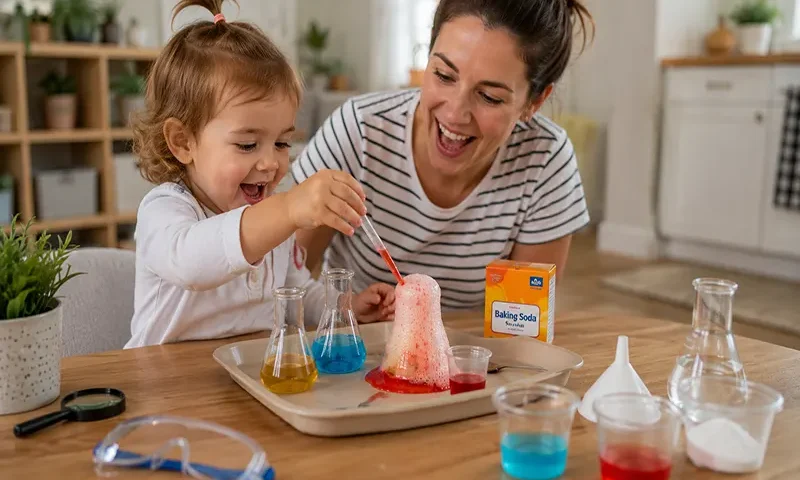
When people hear the word “science,” they often think of laboratories, complex equations, or high-school chemistry kits. But if you watch a toddler for more than five minutes, you will realize that they are the world’s most dedicated scientists. They spend their days testing gravity by dropping spoons, experimenting with acoustics by banging pots, and studying the properties of matter by smearing oatmeal on the table.
For toddlers (ages 1–3), science is not about learning facts; it is about developing a mindset of curiosity. It is about learning that if they do “A,” then “B” will likely happen. By providing simple, safe, and hands-on activities, you can nurture this natural scientist and create meaningful moments of discovery right in your living room or kitchen.
The “Scientific Method” for the High-Chair Set
At this age, the scientific method is simplified into three easy steps: Explore, Predict, and Observe.
When you sit down to play with your toddler, you aren’t trying to teach them the Periodic Table. You are teaching them how to think. You are teaching them that the world is predictable, that actions have consequences, and that asking “What happens if…?” is the most powerful question they can ever ask.
4 Simple Hands-On Science Activities
1. The Buoyancy Battle (Sink or Float)
This is a classic for a reason—it’s intuitive, visual, and infinitely repeatable.
- The Concept: Density and buoyancy.
- The Setup: A large plastic bin or the bathtub filled with water. Gather a collection of household items: a metal spoon, a wooden block, a cork, a plastic toy, a rock, and a leaf.
- The Process: Line up the items. Ask your toddler, “Do you think this will sink to the bottom or float on top?” Drop the item in together and watch the result.
- Why it Matters: This introduces the concept that objects have different physical properties and that not everything interacts with water the same way.
2. The Color-Mixing “Potion” Lab
- The Concept: Understanding solutions and color theory.
- The Setup: Three clear plastic cups filled with water. Add a drop of primary-colored food coloring (red, yellow, blue) to each. Give your toddler a clean dropper or a small turkey baster.
- The Process: Let them mix the colored water into a spare empty cup. “What happens when we add yellow to blue?”
- Why it Matters: This is a gentle introduction to cause-and-effect and the transformation of materials. It also builds fine motor skills through the use of the dropper.
3. The “Magic” Milk Art
- The Concept: Surface tension and chemical reactions (specifically how soap breaks down fat molecules).
- The Setup: A shallow tray or dinner plate, a splash of whole milk, a few drops of food coloring, and a cotton swab dipped in dish soap.
- The Process: Put drops of food coloring into the milk. Have your toddler touch the milk with the soap-dipped cotton swab and watch the colors explode and dance.
- Why it Matters: This is “wow factor” science. It teaches toddlers that things are happening on a microscopic level that we cannot see, but that our actions can trigger visible changes.
4. The Gravity Ramp
- The Concept: Gravity, friction, and slope.
- The Setup: Use a sturdy cardboard box lid or a flat piece of wood as a ramp. Gather a variety of balls (tennis ball, ping-pong ball, a heavy wooden bead).
- The Process: Prop the ramp up on a couch cushion. Roll the different items down. Notice which ones go faster and which ones get stuck.
- Why it Matters: This helps toddlers understand how surfaces (friction) and height (potential energy) change the speed of an object.
Safety and Success Tips
Toddler science should be low-stress. If you are worried about the mess, the science stops and the anxiety begins. Here is how to keep it fun:
- Embrace the “Controlled Mess”: Set up these activities on a large tray, in the bathtub, or on a vinyl tablecloth. If the mess is contained, you won’t mind it as much.
- Ask Open-Ended Questions: Instead of saying “The rock sank because it is heavy,” ask, “Why do you think the rock went to the bottom?” Let them guess. Their answers will be delightful, and their logic—however flawed—is a sign of their brain actively processing data.
- Keep it Short: A toddler’s attention span is short. If they are done after five minutes, don’t force them to continue. The goal is a positive association with exploration, not finishing the “lesson.”
- Safety First: Always supervise. Avoid small objects if your toddler is still prone to putting things in their mouth, and always use food-grade materials (like food coloring or baking soda) whenever possible.
Final Thoughts: The Joy of Discovery
The most important part of these activities isn’t the experiment itself—it’s the way you respond to your toddler’s excitement. When your child drops a ball into the water and laughs, share that laughter. When they ask “Why?”, it is perfectly fine to say, “I’m not sure! Let’s test it again and see if it happens the same way.”
By doing this, you are teaching them that science isn’t just a list of answers in a book; it is a collaborative, ongoing, and thrilling process of discovery. You are building a lifelong learner, one spilled drop of food coloring at a time.

