
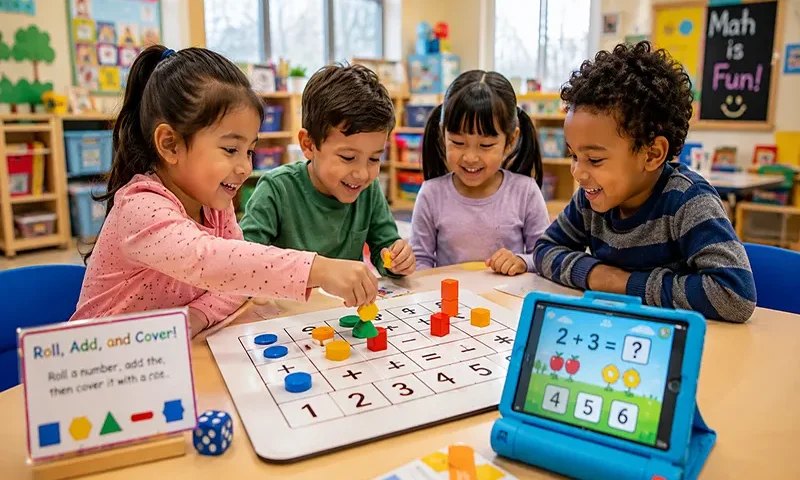
For many, the word “math” conjures images of static worksheets, rote memorization, and daunting columns of numbers. However, for a kindergartener, math is not a subject—it is a language they use to understand the world around them. At age five or six, children are naturally curious, and they learn best through movement, touch, and play. By turning foundational math concepts into interactive games, we can foster a deep-seated love for problem-solving that will serve them for the rest of their lives.
Math at this stage is all about “number sense”—understanding what numbers represent, recognizing patterns, and grasping the basic concepts of addition and subtraction through real-world experience. Here is how you can transform your home or classroom into an interactive math playground.
1. Hands-On and Tactile Games
Tactile learning is essential in kindergarten because it bridges the gap between abstract symbols (like the number “5”) and concrete reality (five physical objects).
The Muffin Tin Sort
Using a standard muffin tin, label each cup with a number (1–12) using masking tape or paper inserts. Provide your child with a bowl of “counters”—these could be pom-poms, dried beans, or plastic dinosaurs.
- The Task: The child must place the correct number of items into each labeled cup.
- Why it Works: This builds one-to-one correspondence, which is the foundational ability to match one number name to one object. It also provides immediate visual feedback; if they put three items in the “2” cup, they can see they have a “remainder.”
LEGO Pattern Towers
Challenge your child to create a “pattern tower.” Use two colors of bricks to create sequences like red-blue-red-blue, or more complex patterns like red-red-blue-red-red-blue.
- Why it Works: Pattern recognition is the precursor to algebra. By identifying and predicting what comes next in a sequence, children are learning the logical structures that underpin all mathematical systems.
2. Movement-Based Math
Kindergarteners are high-energy learners. When you incorporate their entire body into the lesson, the information sticks much more effectively.
Number Hopscotch
Draw a hopscotch grid on the sidewalk with chalk, or use painter’s tape on the living room floor. Instead of just hopping on the numbers, give them a math challenge.
- The Task: Call out an equation (e.g., “What is 2 plus 1?”). The child must hop onto the square that contains the answer.
- Why it Works: This game integrates physical coordination with rapid cognitive recall. It lowers the “stakes” of math, making it feel like a game of tag rather than a test.
The “Math Scavenger Hunt”
Write down numbers on sticky notes and hide them around a room. Then, give your child a “mission.”
- The Task: “Find all the numbers that are bigger than 5,” or “Find the number that comes after 8.”
- Why it Works: This helps with number identification and spatial awareness. Being tasked with “hunting” for math makes them feel like an explorer, turning the act of finding a number into a rewarding achievement.
3. Integrating Math into Daily Routines
One of the most effective ways to teach math is to make it invisible—to make it a natural part of living. You don’t need a curriculum; you just need to talk about numbers.
The Grocery Store Challenge
The supermarket is a goldmine for mathematical discovery.
- Estimation: “How many apples do you think we need to make a pie?”
- Comparison: “Which box of cereal is taller? Which one is heavier?”
- Budgeting: Give them a small budget (e.g., $2) and let them choose between two snacks. This introduces the concept of value and subtraction.
Setting the Table
Asking a child to help set the dinner table is a disguised math lesson.
- The Task: Ask them, “We have four people coming for dinner. How many forks do we need?”
- Why it Works: This encourages subitizing—the ability to instantly “see” how many items are in a small group without counting them one by one. It also reinforces the concept of grouping and division.
4. The Role of Digital and Interactive Tools
While physical play is paramount, digital tools can provide a structured way for children to practice skills independently. When choosing an app, look for those that focus on gamification rather than just digital worksheets.
Quality apps allow children to drag and drop items, see immediate feedback, and progress through levels. The key is to keep screen time brief and collaborative. If your child is using an app, sit with them and ask, “Why did you pick that answer?” or “How did you figure that out?” By articulating their logic, they move from guessing to understanding.
Keep it Playful, Keep it Patient
The goal of teaching math to a kindergartener is never to produce a math prodigy; it is to build a child who is not afraid of a challenge. If a game becomes frustrating, stop. If they lose interest, pivot to something else.
Math is, at its heart, about curiosity. When we frame math as a game rather than a chore, we give children the gift of confidence. By using these simple, interactive strategies, you are showing them that math is not just something they “have to do” in school—it is something they can play with, explore, and master every single day.

